Showing posts with label Gordon's Law. Show all posts
Tuesday, August 20, 2024
I don't think I'm doing this bit all week. I probably could, sure, but...
This is another one I had at some point, and recently pulled from the dollar bins at least twice, so by rule...From 1989, Batman Annual #13, "Faces" Written by James (Priest) Owsley, pencils by Michael Bair, inks by Gray Morrow.
So over on Progressive Ruin, there was a recent discussion about whether or not Commissioner Gordon knows Bruce Wayne is Batman. The consensus is, probably? But he pretends not to know, out of respect for his friend, and doubtless for liability reasons, to protect the department. I'd like that more, if Jim still hung out with Bruce; especially after an issue like this one, where Alfred would be serving brandy and Bruce would have to sit there and nod politely while getting read the riot act secondhand: "Batman absolutely screwed the pooch on this one, Bruce. Completely dropped the ball. The nerve of that guy, who does he think he is...?" Probably a solid 45 minutes of that.
This issue begins with a prologue to (arguably) cheerier times, although it's maybe a brief window, when Jason Todd was Robin and Batgirl was still occasionally active. A cop is killed in a bombing, and Batman tells Gordon it was planted by Freddie Richards, an associate of Two-Face. Both Freddie and Two-Face are captured; and Gordon briefly confronts Batgirl, saying he thought Barbara had hung up the cape: I didn't think he knew that!
Years later, Freddie was going to get the chair for killing a cop, but Bruce watches a tape of a Jack Ryder news special, interviewing members of Two-Face's gang hiding out in Santa Prisca, and one admits he killed the cop Freddie was going to fry for. Batman goes to Gordon to request custody of Two-Face for 72 hours; but doesn't pick the best time: asking him at his wife's grave, with the now-wheelchair bound Barbara. Gordon flatly tells him no; Batman proceeds anyway, disguising himself as a doctor and busting Two-Face out of Gotham. (I wonder if Bats uses his Batman-voice so Harvey knows him, but Two-Face claims he knew immediately.) Batman feels like he helped finger Freddie--ugh, phrasing--and refuses to let him die for a crime he didn't commit, regardless of what he would have to do. Starting with, keeping Two-Face in a cage in the Batcave, while Bruce Wayne plays dumb with Gordon during a Wayne Mansion fundraiser.
Batman and Two-Face hitch a ride on a cargo transport dropping medical supplies for Santa Prisca, and Two-Face is more than a little irritated that his crew has forgotten their place. Batman is more mad, since in the background of the Ryder interview, was the cop that had allegedly been murdered in the first place! He'd been on the take; which doesn't quite line up: Barbara had been a friend of his, she probably would have recognized him and could've backed up Batman's side of this story. Batman suggests Two-Face let the coin decide, but his goons show up first, and his 'coin' is cracked open, revealing some kind of gyroscope: Batman had slipped him a fake! Two-Face is livid, sure, but also disappointed: Bats had cheated, which seemed unworthy of him. He leaves Batman in a death trap, that he of course escapes from; and Batman realizes a crooked cop might find work in a crooked country as a crooked cop again.
While he manages to get both the crooked cop and Two-Face to the airplane, they both take off running, leaving Batman with a perverse Sophie's Choice: he only has time to catch one of them. Batman chooses the cop, and manages to get a stay of execution for Freddie Richards, but Gordon gives him an earful. There had been a body in the bombing, who's to say Freddie didn't kill whoever that had been? He hadn't been an innocent by any account. And what crimes would Two-Face commit while on the loose? Batman knows, he kind of broke his trust with Two-Face, and he could be worse going forward. Let's see if we can run that down: this came out April 1989, and I think Two-Face would next appear shortly in "A Lonely Place of Dying," but that was a crossover with Titans and introduced Tim Drake, right? I don't know if this issue was mentioned. And Priest would get to write some Batman again, but it would be a while.
Also this issue: "Waiting in the Wings," by Kevin Dooley and Malcolm Jones III. Mid-Year One, Alfred tells Bruce he's quitting, to pursue his acting career. (Spoiler alert: he doesn't!) There's also several updated Who's Who style pages, including one for Vicki Vale, who had virtually been written out of the book by then.
Read more!
Labels:
Batgirl,
Batman,
Gordon's Law,
Priest,
Robin,
three times,
Two-Face
Friday, June 10, 2022
Set the Way-Back Machine for...2016?! I thought this was twenty years ago, easy.
I mean, I got the action figure for it in 2017, which impossibly feels even longer ago. It's always disappointing when a long-standing character gets a redesign that's very obviously not going to stick around long-term, yet sometimes still gets an action figure. Hal and Sonar also don't have their classic looks either, because it was apparently time to try something new, as in something old...from 2016, Green Lantern #48, "Close to Home" Written by Robert Venditti, pencils by Martin Coccolo and Billy Tan, inks by Martin Coccolo and Mark Irwin.
Hal was a fugitive from the Green Lantern Corps at this point, and instead of the traditional power ring was using a prototype power...glove, thing. His nephew Howard was among those injured in a bombing, the work of long-time GL foe Sonar. Despite having fought him about 80 times, Hal flies from Coast City to Gotham for intel from Batman...so who's this armored bunny-guy? It's Jim Gordon, in his cup-of-coffee replacement stint as Batman! Hal's still able to browbeat the 'Rookie' into making with the information, since, hey, Batman would've, right? Sonar was still fighting for Modoran independence, and had taken leadership of the separatist front with sound-powered bombs. The Rookie lets him know the Modarans had a training facility in Kahndaq: GL flies over to try and shake them down, but they kill themselves with those bombs rather than spill. Furious he was getting nowhere, Hal demolishes, then buries, the terrorists and their base; while asking his nephew not to die.
Meanwhile, in space, more specifically the space where Oa is supposed to be, Parallax isn't thrilled that Oa is gone and the universe had "Sinestro-worshippers," but at least Coast City was still okay, right? Better keep it that way...by getting rid of Hal Jordan.
Woof, this issue also features ads for the last X-Files episodes, and Dark Knight III: the Master Race, more things that have aged terribly. (I just stared into space trying to think of something better than 'like a piece of Fruit Stripe gum after three chews,' or my go-to, 'like a microwaved banana.')
Read more!
Monday, March 11, 2013
"Reuse, reuse, and recycle."

Got John Constantine a week or two back, and I've got a strip planned with him for Wednesday. Without the "Trenchcoat Brigade," I'm afraid.
Rorschach, the Question, Constantine, and Commissioner Gordon aren't all the same body; but pretty close.

Read more!
Labels:
Constantine,
Gordon's Law,
Question,
the Question,
Watchmen
Wednesday, October 31, 2012
"Knight-Blindness."
Part of the idea for this one came to me the other day as I walked to work: I checked my phone, and the light completely wrecked my night vision (it's five-thirty or so in the morning when I walk!) but I swear some of Batman's tricks have been in the comics. Just don't ask me where or when...
Read more!
Friday, October 12, 2012
Build a working, non-working Bat-Signal!
Since we've been running a bit toy-heavy this week anyway, we'll wrap up with a quick glance at the Movie Masters Bat-Signal! Which isn't actually done yet. I picked up "GCPD Blake" the other day for a mere $8.99; which almost makes me want to find another one and swap the head with one of the spares I have floating around, and expand the force a bit. Not a bad figure, could use a gun or a more gun-ready hand.
I have yet to see a R'as Al Ghul/Liam Neeson figure yet, so my Bat-Signal lacks innards. It doesn't light up yet, but the lighting and the lens make it look on. Weird. The background piece today is from the Young JusticeSpeedy Red Arrow set, and may actually be the reason that figure was purchased.
That's it for this week, so have a good weekend!
Read more!
I have yet to see a R'as Al Ghul/Liam Neeson figure yet, so my Bat-Signal lacks innards. It doesn't light up yet, but the lighting and the lens make it look on. Weird. The background piece today is from the Young Justice
That's it for this week, so have a good weekend!
Read more!
Labels:
Batman,
Batman copycats,
Gordon's Law,
homemade posts
Wednesday, August 08, 2012
"Of Batmen and Bat-Signals."
Although I'm back from vacation now, as I write this I don't go back to work until tomorrow. The temptation was to spend the evening scratching lottery tickets in the futile hope that I'd win enough to not have to go back, but I refrained and bought a couple figures instead. (I did buy a Powerball, since tonight's drawing is probably in the $240 million dollar range; even after taxes I'd clear enough to make an action figure of myself...)
The Azrael-Batman there (reviewed over at OAFE.net, which called the repaint a year ago) may or may not be available locally yet: I know he's going to be in a two-pack with a battle-damaged Batman, but I got him off eBay for $15.50. Not bad, but beware: this was shipped from China and may be a factory-second figure. The left wrist on mine was broken and glued back on; and there may be a bit of warping on the cape pieces. The chest emblem is missing a touch of paint as well. Those aren't deal-breakers for me, though; and the cape could definitely be adjusted. The left hand is currently held on with putty, which does keep the articulation!
We will probably see Azrael-Bats again--although, thanks to my scheduling, I'm not sure when. The replacement Batman from Knightfall, Jean-Paul Valley carried a solo title for over a hundred issues, first as Azrael (with a #1,000,000 issue) then as Azrael: Agent of the Bat. I'm not sure I've read more than a couple of them, but I had an idea on bringing him back...
I also got the Movie Masters Batman and Bane, on sale at K-Mart right about now for $12.79 or so. I guess the Batman is the same as the one from the Dark Knight, which I've had on the Bat-Pod on my entertainment center for...ever, judging by the dust that was on him. So, I have four-ish pieces of the Bat-Signal, out of a possible six.
OK, that's not quite right: the Youngest got some Fisher-Price Trio Batman sets, with Batman and the Joker, and Robin and the Riddler. They were little character two-packs, marked half-off, with a few block-pieces.
I have the Movie Masters Batman, Bane, Gordon, and Dale got me Alfred. Which puts us here: Gordon came with the smashed Bat-signal cover. I don't know if I'd display it that way, but I have yet to see a Catwoman figure, let alone the other two. Eventually...
Read more!
The Azrael-Batman there (reviewed over at OAFE.net, which called the repaint a year ago) may or may not be available locally yet: I know he's going to be in a two-pack with a battle-damaged Batman, but I got him off eBay for $15.50. Not bad, but beware: this was shipped from China and may be a factory-second figure. The left wrist on mine was broken and glued back on; and there may be a bit of warping on the cape pieces. The chest emblem is missing a touch of paint as well. Those aren't deal-breakers for me, though; and the cape could definitely be adjusted. The left hand is currently held on with putty, which does keep the articulation!
We will probably see Azrael-Bats again--although, thanks to my scheduling, I'm not sure when. The replacement Batman from Knightfall, Jean-Paul Valley carried a solo title for over a hundred issues, first as Azrael (with a #1,000,000 issue) then as Azrael: Agent of the Bat. I'm not sure I've read more than a couple of them, but I had an idea on bringing him back...
I also got the Movie Masters Batman and Bane, on sale at K-Mart right about now for $12.79 or so. I guess the Batman is the same as the one from the Dark Knight, which I've had on the Bat-Pod on my entertainment center for...ever, judging by the dust that was on him. So, I have four-ish pieces of the Bat-Signal, out of a possible six.
OK, that's not quite right: the Youngest got some Fisher-Price Trio Batman sets, with Batman and the Joker, and Robin and the Riddler. They were little character two-packs, marked half-off, with a few block-pieces.
I have the Movie Masters Batman, Bane, Gordon, and Dale got me Alfred. Which puts us here: Gordon came with the smashed Bat-signal cover. I don't know if I'd display it that way, but I have yet to see a Catwoman figure, let alone the other two. Eventually...
Read more!
Labels:
Azrael,
Bane,
Batman,
build-a-figure chronicles,
Gordon's Law,
homemade posts
Monday, July 23, 2012
No one asked, but about the Dark Knight Rises:
Ooh, spoilers. Obscure points ahead!
Short answer? I really liked it, both by itself but especially as part of a trilogy. But I'm looking forward to more Batman...in a different way.
I don't know how it would be coming in cold, but Nolan's Dark Knight Rises isn't just a great conclusion to his Batman trilogy, the way various plot points and moments come together make it more cohesive than any other movie trilogy I could name. Catwoman and Bane were both great: just about everything that was wrong with them in their other movies, Nolan gets right. (There's another villain briefly in late, that's also great.) While some plot points were a bit telegraphed, there were others that were genuinely surprising to me, even though I went well out of my way to avoid spoilers. Still, a couple of thoughts:
It bothered me that Batman's career was really short: I thought he may have seen a little action after the Dark Knight, but how did he wreck his knee? Running from the cops? Every so often in the comics, Batman and the police force's working relationship goes south, but the motorcycle chase scene really underlined what a pain in the ass it would be to work like that.
The Dent Act seems like something Batman would not be OK with, either. I misheard it and thought it was a thousand mobsters locked up without due process; when I think it was probably "just" without parole; but it was based on a lie, and to me it seems pretty likely that out of that thousand, there has to be someone who doesn't deserve eight years in the joint: I don't think Batman would stand for one innocent person suffering to keep a thousand criminals locked up. Gordon might compromise and choke that one down, but it would hurt.
While it sets up a later point, I didn't like Alfred and Bruce's last conversation. I just can't see either one of them not forgiving the other, for anything; although I figure Alfred had to be taken off the board there.
Weird, it's President Henry Hayes! Guess we know what universe this is the Batman of...
I don't know if this point was made clear, or if I missed it, but the fusion clean-energy project was heavily invested in by Wayne Industries, but was proposed by Miranda Tate. An important distinction, since without that point it really makes Wayne's attempts to improve the world colossal failures across the board. (Let's keep all these weapons safe in our basement...) Did you trust Miranda, at all? I think I knew going in that she wasn't what she seemed, although she did surprise me once or twice.
I didn't have a problem with the character of Blake, but...and big spoiler here: in the end, when Bruce leaves him the cave, did you think, "so what?" Can Blake become a Batman, or another symbol, without that fat Wayne bank backing him up? I suppose there may be some remnants of Tumblers and other gear floating around for him to scavenge--and I was momentarily hoping one of those destroyed Tumblers would spit out a Batpod, too.
But, and keep in mind I really enjoyed all three movies, Nolan's more real-world take on the Batman isn't necessarily the Batman you might have in your head, is it? Personally, my Batman is agile--less Frank Miller, more Marshall Rogers or Alan Davis or Jim Aparo or Norm Breyfogle. Next Batman movie--and we all know it's coming, which I'm fine with--I want a Batman that can move, that isn't armored up to the point that he can't turn his neck. Picture Batman, in the cave, cowl off, training with parallel bars: that shows a level of strength, balance and coordination that I don't think a live-action Batman has brought to play yet.
If I was writing or directing the next Batman--and yeah, no one's asking!--I would keep it away from anything Nolan's done. No origin, everyone knows it. No training montage. Show Bats doing some detective work, for god's sake. Open with a youngish Batman, in his prime, against a super-powered foe or two: someone visually impressive, but not deep enough to build a whole movie around; just to show Batman as someone who has trained and equipped himself to be more than a match for anything. Maybe Blockbuster or Amygdala...
Read more!
Short answer? I really liked it, both by itself but especially as part of a trilogy. But I'm looking forward to more Batman...in a different way.
I don't know how it would be coming in cold, but Nolan's Dark Knight Rises isn't just a great conclusion to his Batman trilogy, the way various plot points and moments come together make it more cohesive than any other movie trilogy I could name. Catwoman and Bane were both great: just about everything that was wrong with them in their other movies, Nolan gets right. (There's another villain briefly in late, that's also great.) While some plot points were a bit telegraphed, there were others that were genuinely surprising to me, even though I went well out of my way to avoid spoilers. Still, a couple of thoughts:
It bothered me that Batman's career was really short: I thought he may have seen a little action after the Dark Knight, but how did he wreck his knee? Running from the cops? Every so often in the comics, Batman and the police force's working relationship goes south, but the motorcycle chase scene really underlined what a pain in the ass it would be to work like that.
The Dent Act seems like something Batman would not be OK with, either. I misheard it and thought it was a thousand mobsters locked up without due process; when I think it was probably "just" without parole; but it was based on a lie, and to me it seems pretty likely that out of that thousand, there has to be someone who doesn't deserve eight years in the joint: I don't think Batman would stand for one innocent person suffering to keep a thousand criminals locked up. Gordon might compromise and choke that one down, but it would hurt.
While it sets up a later point, I didn't like Alfred and Bruce's last conversation. I just can't see either one of them not forgiving the other, for anything; although I figure Alfred had to be taken off the board there.
Weird, it's President Henry Hayes! Guess we know what universe this is the Batman of...
I don't know if this point was made clear, or if I missed it, but the fusion clean-energy project was heavily invested in by Wayne Industries, but was proposed by Miranda Tate. An important distinction, since without that point it really makes Wayne's attempts to improve the world colossal failures across the board. (Let's keep all these weapons safe in our basement...) Did you trust Miranda, at all? I think I knew going in that she wasn't what she seemed, although she did surprise me once or twice.
I didn't have a problem with the character of Blake, but...and big spoiler here: in the end, when Bruce leaves him the cave, did you think, "so what?" Can Blake become a Batman, or another symbol, without that fat Wayne bank backing him up? I suppose there may be some remnants of Tumblers and other gear floating around for him to scavenge--and I was momentarily hoping one of those destroyed Tumblers would spit out a Batpod, too.
But, and keep in mind I really enjoyed all three movies, Nolan's more real-world take on the Batman isn't necessarily the Batman you might have in your head, is it? Personally, my Batman is agile--less Frank Miller, more Marshall Rogers or Alan Davis or Jim Aparo or Norm Breyfogle. Next Batman movie--and we all know it's coming, which I'm fine with--I want a Batman that can move, that isn't armored up to the point that he can't turn his neck. Picture Batman, in the cave, cowl off, training with parallel bars: that shows a level of strength, balance and coordination that I don't think a live-action Batman has brought to play yet.
If I was writing or directing the next Batman--and yeah, no one's asking!--I would keep it away from anything Nolan's done. No origin, everyone knows it. No training montage. Show Bats doing some detective work, for god's sake. Open with a youngish Batman, in his prime, against a super-powered foe or two: someone visually impressive, but not deep enough to build a whole movie around; just to show Batman as someone who has trained and equipped himself to be more than a match for anything. Maybe Blockbuster or Amygdala...
Read more!
Friday, June 15, 2012
Late: Commissioner Gordon!
It's getting late, I'm half-watching Mothra, and I'm playing with the new Wal-Mart exclusive Mattel Movie Masters Jim Gordon! Oddly, he's not referred to as Commissioner on the packaging, which only just now makes me wonder what his title is at the start of The Dark Knight Rises.
Just knocked out a couple of short ones with the Commish...and I misspelled Commissioner there. Crap. Well, it's late, and I'm sure it won't happen again--
Oh, come on!
Still, Jim comes with a gun, an ax, and an alternate piece for the Collect & Connect Bat-Signal that's shattered; as in the end of the Dark Knight. (Which is cool, although that is kind of a weird scene if you think about it.)
I didn't spring for the previous Prototype-suit Batman/Lt. Jim Gordon two pack, so I'm pretty happy with him. He'll be making some appearances later, no doubt.
Read more!
Thursday, September 15, 2011
80-Page Thursdays: Gotham Freezes Over!

During the Comic Book Shop's 23rd anniversary sale, I picked up a nice pile of 80-pagers on the cheap, so we'll take this next month or so to look one every Thursday.
It was over eighty degrees today (when I wrote this) but now we look at Gotham City in the midst of it's worst blizzard in memory...or, at least it is in some of the stories. The opening story sets that up, with the city losing basic services and in worse shape than it was in No Man's Land, according to Dick. In tales with Catwoman and Poison Ivy, it does look like a cold day in Gotham. But, it seems to be doing alright in some of the other stories.

In one, Alfred helps out a prostitute; while there are newer vigilantes in town, the Saint and the Veil. (The Veil looks quite a bit like Dark Horse's Ghost, to me.) Catwoman helps an old scientist and faces an old rival, and while I liked the art in that one, I think my favorite story was Commissioner Gordon versus Mr. Freeze.

While Gordon is freezing his ass off, Freeze is making the most of the weather, since he can roam around in it without his suit. Or his gun, although he still kills a few guys without it: Freeze wacks a couple of Black Mask's men, to make the case to Gordon that he should be allowed out of prison for a few "snow days." Gordon almost seems to be considering it...
Tons of credits in this one, but we've got scans from "Fire & Ice" Written by Kevin Grevioux, pencils by Grey, inks by Nelson X. Asencio; "No Two Alike" written by Ivory Madison, art by Kat Rocka and Josh Finney; and "What Falls Below" written by Kevin Shinick, art and colors by Rafa Garres.
Read more!
Labels:
80-pagers,
Batman,
Gordon's Law,
oldschool Catwoman,
Robin
Thursday, December 11, 2008
Last time, on Gordon's Law:
Gordon's Law #3 opens with the commissioner's second nightmare of the series, so he hasn't done much yet. Well, compared to Batman or the Punisher or something, I suppose; for a police commissioner he's pretty hands-on. After telling Sarah he's fine but doesn't want her involved, Gordon meets with Thorpe (the dirty F.B.I. agent) and Shotgun Smith (the presumably clean county sheriff). Gordon tasks them to find Junior Manklin, while he checks out the two-nine precinct, which may be involved in the federal reserve robbery.
Thorpe excuses himself to run down some leads, in this case, reporting directly to Manklin. Manklin doesn't buy that Gordon doesn't have more leads, and has to go to his boss for instructions. But first, he's distracted by new face Red Corona chatting up his girl.
Gordon stops by a cop bar near the two-nine, which goes silent as he enters. The son of Gordon's old friend Dougherty, Tim, makes small talk, but then leaves scowling.
Thorpe leads Shotgun into a trap, although they don't kill him yet, wanting to get information on Gordon's investigation first. Gordon calls Sarah and leaves a message, that unless Shotgun has some info for him, he might have to turn the investigation over to the feds, so of course a clue falls in his lap. Wait, clue? More like a hit attempt. In a Manklin Brothers truck. Not subtle, are they? Gordon takes them both out, including one in an explosion. Ducking under the water, he ends up washed out down a storm drain the next issue.
Undercover officer Bell has missed another meeting, and the detectives start to worry. Meanwhile, Junior Manklin seems pretty secure right about now:


Stuff's starting to happen, eh? I was gonna drag this out another day, but let's just wrap it up: a soggy Gordon makes his way back to his office, still in his trench coat. That's commitment. Unfortunately, someone left him a present on his desk: the body of Red Corona, with a note: "This little piggy ran all the way home." Gordon has no idea who he is, another fallen cop. Dejected and exhausted, Gordon calls out for help from a higher power, only to find nothing. No, not God; Batman:

Meanwhile, Shotgun Smith effects a daring, if pretty easy, escape: shoving Tim Dougherty out a window, landing on him, and getting the hell out of there. All while tied up, in a trench coat. Later, Gordon arrives at the scene, and since no one knows he's dirty, the cops are out in full force. Gordon is told Thorpe called in Dougherty's death, calling it a bust gone bad.
Manklin is thrilled at Thorpe's dropping the ball on Smith: Thorpe says he probably died in the fall, but Smith's made his way to his partner's house to lie low. And Gordon has just realized, the dead snitch's last word, "Doc," could have been "Dougherty." Somehow. The senior Dougherty, Pat, plays the grieving father to the officers that visit him; but behind closed doors is furious that Tim was so stupid.
And now we're halfway through the last issue, so things start to pick up: Manklin shows up, with his crew and Thorpe; to tell Dougherty he's tired of taking all the risk of laundering the money while Dougherty can hide behind his badge. Gordon shows up before things escalate, and puts together...a bunch of clues the reader wouldn't have access to.

This is why I've been going through this whole series almost page-by-page, to see if all the clues were there, and they weren't, no. Although, and I was among those that criticized Hush for this; comics have a pretty long-running standard: new friend/mentor/relative/love interest of the hero introduced in a story? They're probably the bad guy. It's a bit Scooby-Do, yeah, but most comics don't usually have the time/page count to establish a real mystery, and even if they did, wouldn't it just confuse most readers? And after four months, who remembers anyway?
Back to the story: the inevitable shootout ensues, and Dougherty and Manklin and his men are gunned down. Gordon's hit, and Thorpe just has to finish him off, collect the cash, and walk away: he's a real Fed, but "I took some vacation time. I kill you, and no one even knows I was here. Just another freak shootout in Gotham." Great plan, Thorpe, except you called in the younger Dougherty's death. Probably not too great of a leap to get to you...
Luckily for Gordon, there's still one player we haven't heard from yet. No, NOT BATMAN.
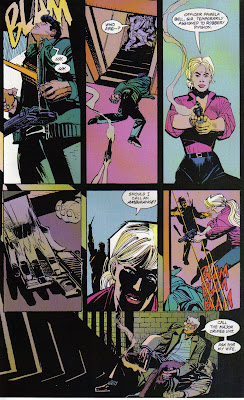
So officer Bell turns out to have been Manklin's girlfriend. Which brings to mind the terrible, terrible things she probably had to do to get under cover (so to speak) but even though she was only seen in shadows the rest of the series, she was pretty obviously a guy every time, yeah. Dixon and Janson=cheaters! (Although, they were able to avoid any gender-specific pronouns discussing Bell, and that was hard to do just writing this!)
In the end, Smith is due to be released from the hospital, Bullock apologizes to Gordon for not trusting him, and Gordon does the same to Batman. Batman brushes it off, saying he knew Gordon could handle it.
So, on the whole, Gordon's Law probably wasn't worth $7.80 in 1997, but considering I paid a dollar for the series, it's enjoyable enough fluff; and I like Janson's art. (I didn't always: he did a Star Wars Annual when I was a kid that I hated.) If you've ever thought to yourself, damn, I wish Commissioner Gordon would bust some caps, then there you go. I think, and may even have lying around from the same purchase, another Gordon-centric limited, and the one-shot Bullock's Law. None of which were anywhere near as good as Gotham Central, and I hardly have any damn issues of that. Crap. Read more!
Gordon's Law #3 opens with the commissioner's second nightmare of the series, so he hasn't done much yet. Well, compared to Batman or the Punisher or something, I suppose; for a police commissioner he's pretty hands-on. After telling Sarah he's fine but doesn't want her involved, Gordon meets with Thorpe (the dirty F.B.I. agent) and Shotgun Smith (the presumably clean county sheriff). Gordon tasks them to find Junior Manklin, while he checks out the two-nine precinct, which may be involved in the federal reserve robbery.
Thorpe excuses himself to run down some leads, in this case, reporting directly to Manklin. Manklin doesn't buy that Gordon doesn't have more leads, and has to go to his boss for instructions. But first, he's distracted by new face Red Corona chatting up his girl.
Gordon stops by a cop bar near the two-nine, which goes silent as he enters. The son of Gordon's old friend Dougherty, Tim, makes small talk, but then leaves scowling.
Thorpe leads Shotgun into a trap, although they don't kill him yet, wanting to get information on Gordon's investigation first. Gordon calls Sarah and leaves a message, that unless Shotgun has some info for him, he might have to turn the investigation over to the feds, so of course a clue falls in his lap. Wait, clue? More like a hit attempt. In a Manklin Brothers truck. Not subtle, are they? Gordon takes them both out, including one in an explosion. Ducking under the water, he ends up washed out down a storm drain the next issue.
Undercover officer Bell has missed another meeting, and the detectives start to worry. Meanwhile, Junior Manklin seems pretty secure right about now:
Stuff's starting to happen, eh? I was gonna drag this out another day, but let's just wrap it up: a soggy Gordon makes his way back to his office, still in his trench coat. That's commitment. Unfortunately, someone left him a present on his desk: the body of Red Corona, with a note: "This little piggy ran all the way home." Gordon has no idea who he is, another fallen cop. Dejected and exhausted, Gordon calls out for help from a higher power, only to find nothing. No, not God; Batman:
Meanwhile, Shotgun Smith effects a daring, if pretty easy, escape: shoving Tim Dougherty out a window, landing on him, and getting the hell out of there. All while tied up, in a trench coat. Later, Gordon arrives at the scene, and since no one knows he's dirty, the cops are out in full force. Gordon is told Thorpe called in Dougherty's death, calling it a bust gone bad.
Manklin is thrilled at Thorpe's dropping the ball on Smith: Thorpe says he probably died in the fall, but Smith's made his way to his partner's house to lie low. And Gordon has just realized, the dead snitch's last word, "Doc," could have been "Dougherty." Somehow. The senior Dougherty, Pat, plays the grieving father to the officers that visit him; but behind closed doors is furious that Tim was so stupid.
And now we're halfway through the last issue, so things start to pick up: Manklin shows up, with his crew and Thorpe; to tell Dougherty he's tired of taking all the risk of laundering the money while Dougherty can hide behind his badge. Gordon shows up before things escalate, and puts together...a bunch of clues the reader wouldn't have access to.
This is why I've been going through this whole series almost page-by-page, to see if all the clues were there, and they weren't, no. Although, and I was among those that criticized Hush for this; comics have a pretty long-running standard: new friend/mentor/relative/love interest of the hero introduced in a story? They're probably the bad guy. It's a bit Scooby-Do, yeah, but most comics don't usually have the time/page count to establish a real mystery, and even if they did, wouldn't it just confuse most readers? And after four months, who remembers anyway?
Back to the story: the inevitable shootout ensues, and Dougherty and Manklin and his men are gunned down. Gordon's hit, and Thorpe just has to finish him off, collect the cash, and walk away: he's a real Fed, but "I took some vacation time. I kill you, and no one even knows I was here. Just another freak shootout in Gotham." Great plan, Thorpe, except you called in the younger Dougherty's death. Probably not too great of a leap to get to you...
Luckily for Gordon, there's still one player we haven't heard from yet. No, NOT BATMAN.
So officer Bell turns out to have been Manklin's girlfriend. Which brings to mind the terrible, terrible things she probably had to do to get under cover (so to speak) but even though she was only seen in shadows the rest of the series, she was pretty obviously a guy every time, yeah. Dixon and Janson=cheaters! (Although, they were able to avoid any gender-specific pronouns discussing Bell, and that was hard to do just writing this!)
In the end, Smith is due to be released from the hospital, Bullock apologizes to Gordon for not trusting him, and Gordon does the same to Batman. Batman brushes it off, saying he knew Gordon could handle it.
So, on the whole, Gordon's Law probably wasn't worth $7.80 in 1997, but considering I paid a dollar for the series, it's enjoyable enough fluff; and I like Janson's art. (I didn't always: he did a Star Wars Annual when I was a kid that I hated.) If you've ever thought to yourself, damn, I wish Commissioner Gordon would bust some caps, then there you go. I think, and may even have lying around from the same purchase, another Gordon-centric limited, and the one-shot Bullock's Law. None of which were anywhere near as good as Gotham Central, and I hardly have any damn issues of that. Crap. Read more!
Wednesday, December 10, 2008
Gordon's Law #2 brings more characters into the mix, but first one leaves: Gordon asks Bullock in on the investigation on the federal robbery, and he's in...until he hears that Gordon thinks cops were involved. Bullock refuses to go all snitchy and leaves, claiming Gordon's source Hoagland is "just blowing smoke to cop a plea."
Meanwhile, Junior Manklin makes the scene at a nightclub, blond in tow; and makes a payoff to a man named Thorpe, with bills from the robbery. A young man at the bar wants to meet Junior...no, not like that...
Elsewhere, Gordon calls in a favor with county sheriff Steve "Shotgun" Smith. Pretty sure he first appeared in a Dixon-written issue of Robin. Gordon wants Smith in since although Smith was busted out of G.C.P.D. Gordon knows he's clean. They meet with their F.B.I. help: Thorpe.
Leaving the club, joyriders nearly steal Manklin's car, but the man from the bar stops them. He introduces himself as Red Corona, and wants in. Manklin is suspicious:

I thought it was traditional to get a room before the strip search, but oh well.
Hoagland gives Gordon, a "taste" of his information: the forty-sixth precinct. In return, he wants "a nice cell with the snitches and short eyes," whatever that last one is. Two pages later, he's killed in his cell, lasting long enough to only tell Gordon, "Doc."
Elsewhere, undercover officer Bell makes a meet with a plainclothes detective; we still don't get to see his face. Thorpe meets with Manklin, asking for more cash for giving up Hoagland. Manklin's boss, presumably the one behind the robbery, has Manklin punch Thorpe in the gut and gives him new orders: "Lead them a chase."
Man, I can't imagine reading this series month-to-month. I got all four issues at once, but so far the identity of officer Bell is the big secret: we already know Thorpe's dirty, and don't have clue one who masterminded the heist. Or do we? Well, I don't. We'll see if there's any clues tomorrow. Read more!
Meanwhile, Junior Manklin makes the scene at a nightclub, blond in tow; and makes a payoff to a man named Thorpe, with bills from the robbery. A young man at the bar wants to meet Junior...no, not like that...
Elsewhere, Gordon calls in a favor with county sheriff Steve "Shotgun" Smith. Pretty sure he first appeared in a Dixon-written issue of Robin. Gordon wants Smith in since although Smith was busted out of G.C.P.D. Gordon knows he's clean. They meet with their F.B.I. help: Thorpe.
Leaving the club, joyriders nearly steal Manklin's car, but the man from the bar stops them. He introduces himself as Red Corona, and wants in. Manklin is suspicious:
I thought it was traditional to get a room before the strip search, but oh well.
Hoagland gives Gordon, a "taste" of his information: the forty-sixth precinct. In return, he wants "a nice cell with the snitches and short eyes," whatever that last one is. Two pages later, he's killed in his cell, lasting long enough to only tell Gordon, "Doc."
Elsewhere, undercover officer Bell makes a meet with a plainclothes detective; we still don't get to see his face. Thorpe meets with Manklin, asking for more cash for giving up Hoagland. Manklin's boss, presumably the one behind the robbery, has Manklin punch Thorpe in the gut and gives him new orders: "Lead them a chase."
Man, I can't imagine reading this series month-to-month. I got all four issues at once, but so far the identity of officer Bell is the big secret: we already know Thorpe's dirty, and don't have clue one who masterminded the heist. Or do we? Well, I don't. We'll see if there's any clues tomorrow. Read more!
Tuesday, December 09, 2008
One of the more enjoyable things about the Dark Knight was that for the first time in years of Batman TV shows, cartoons, and movies; we had a competent, capable, and hardcore Commissioner Jim Gordon. Although the role gets overshadowed since it's not the flashy one, Gary Oldman builds up the character a lot; making it clear that the fate of Gotham City isn't resting on Batman's shoulders alone. Previously, Gordon had been portrayed as a likable if harmless-seeming authority figure; and it was pretty obvious Batman was the one who got things done in Gotham. (The recent the Batman animated series may have been on the right track with former X-Files actor Mitch Pileggi as the voice of Commissioner Gordon, but I can't recall him getting a whole ton to do...)
But every so often in the comics, when he's not a hostage, or a talking head to deliver exposition to Batman, or catching flak for needing a costumed vigilante to help him police the city; so not very often at all then...but sometimes, we get to see Gordon being a cop. Sometimes. It may be a fine line to walk: if Gordon is too good of a cop, why would he need Batman? And the rampant graft and corruption of Batman: Year One has to be reined in a bit, or that really makes Gordon seem incompetent.
So, this week we're going to take a couple of looks at a moment for the commissioner to shine: the 1997 mini-series Gordon's Law, written by Chuck Dixon, art by Klaus Janson. The story opens with a bad one: Robbery at a federal reserve bank, with hostages. Gordon arrives as the cops receive word the first hostage has been killed; but the building is too fortified for tactical/SWAT teams to take it. They receive a call from a squad car in a shootout a couple blocks away, that armed men are making for a car, and Gordon deduces the robbers blew through a subway line and are trying to get back out there.
Redeploying forces to cover their escape, Gordon and some men stay behind to go into the bank for the hostages. Before he goes in, though, Bullock calls Gordon: they've got their area locked down, but no sign of an explosion, a shootout, or the robbers. They hadn't, in fact, gone anywhere yet, and in an armored car plow through the men remaining.

At the funeral for the lost officers, Pat Dougherty approaches Jim to give his condolences. He's introduced to Barbara and Sarah Essen (and the reader) as having "adopted Jimmy when he was new to Gotham." Neither Barbara nor Sarah like him within moments of meeting him. Dougherty tells Gordon he's at the four-six precinct now if he needs him.
Months later, some of the money has been found in unrelated raids, and an uncirculated thousand-dollar bill from the heist is found pinned to a corpse in Gotham. Gordon discusses the case with Batman, but won't give him the bill to examine. They suspect the Manklin crime family of at least moving the money, but probably too-small time for the heist itself. Gordon seems insanely frustrated by the lack of leads.

Meanwhile, the chief of detectives offers an undercover post to a new rookie. Shades of the Departed, although this one predates that movie by like a decade. I can see why they use rookies--they won't be recognized, unlike the guy driving a squad car for five years--but they have no experience, either. We don't see Officer Bell's face, but on the previous page we see Batman swing by while their conversation starts, so it's not Batman. Probably.
Later, a vice bust runs across a traditional-looking cement overshoes party. Does anyone still do that, or are there easier ways of ditching a body now? One of the perps, "Checkers" Hoagland, contacts Gordon about a deal; and gives him a hotel that has something in the safe for him: another of the thousand-dollar bills from the heist. "Checkers" wants a manslaughter charge instead of murder ("I only mixed the cement, for god's sake.") but will only talk to Gordon, no testimony. Since the fed heist was pulled off, by cops.
That would explain how the robbers used the emergency frequencies for a diversion. Gordon goes to listen to the tapes of that evening, only to find they had been wiped. He begins to set up a deal for Hoagland. Batman meets with Gordon with some info on the Manklins, and Gordon tells him to butt out. This one, is a police matter. Batman seems almost bemused at first: "Aren't they all?" Gordon goes off on him then:

This one's running a little long, so we'll take a look at the rest of the series later; especially since there's a twist that's a bit of a cheat. Read more!
But every so often in the comics, when he's not a hostage, or a talking head to deliver exposition to Batman, or catching flak for needing a costumed vigilante to help him police the city; so not very often at all then...but sometimes, we get to see Gordon being a cop. Sometimes. It may be a fine line to walk: if Gordon is too good of a cop, why would he need Batman? And the rampant graft and corruption of Batman: Year One has to be reined in a bit, or that really makes Gordon seem incompetent.
So, this week we're going to take a couple of looks at a moment for the commissioner to shine: the 1997 mini-series Gordon's Law, written by Chuck Dixon, art by Klaus Janson. The story opens with a bad one: Robbery at a federal reserve bank, with hostages. Gordon arrives as the cops receive word the first hostage has been killed; but the building is too fortified for tactical/SWAT teams to take it. They receive a call from a squad car in a shootout a couple blocks away, that armed men are making for a car, and Gordon deduces the robbers blew through a subway line and are trying to get back out there.
Redeploying forces to cover their escape, Gordon and some men stay behind to go into the bank for the hostages. Before he goes in, though, Bullock calls Gordon: they've got their area locked down, but no sign of an explosion, a shootout, or the robbers. They hadn't, in fact, gone anywhere yet, and in an armored car plow through the men remaining.
At the funeral for the lost officers, Pat Dougherty approaches Jim to give his condolences. He's introduced to Barbara and Sarah Essen (and the reader) as having "adopted Jimmy when he was new to Gotham." Neither Barbara nor Sarah like him within moments of meeting him. Dougherty tells Gordon he's at the four-six precinct now if he needs him.
Months later, some of the money has been found in unrelated raids, and an uncirculated thousand-dollar bill from the heist is found pinned to a corpse in Gotham. Gordon discusses the case with Batman, but won't give him the bill to examine. They suspect the Manklin crime family of at least moving the money, but probably too-small time for the heist itself. Gordon seems insanely frustrated by the lack of leads.
Meanwhile, the chief of detectives offers an undercover post to a new rookie. Shades of the Departed, although this one predates that movie by like a decade. I can see why they use rookies--they won't be recognized, unlike the guy driving a squad car for five years--but they have no experience, either. We don't see Officer Bell's face, but on the previous page we see Batman swing by while their conversation starts, so it's not Batman. Probably.
Later, a vice bust runs across a traditional-looking cement overshoes party. Does anyone still do that, or are there easier ways of ditching a body now? One of the perps, "Checkers" Hoagland, contacts Gordon about a deal; and gives him a hotel that has something in the safe for him: another of the thousand-dollar bills from the heist. "Checkers" wants a manslaughter charge instead of murder ("I only mixed the cement, for god's sake.") but will only talk to Gordon, no testimony. Since the fed heist was pulled off, by cops.
That would explain how the robbers used the emergency frequencies for a diversion. Gordon goes to listen to the tapes of that evening, only to find they had been wiped. He begins to set up a deal for Hoagland. Batman meets with Gordon with some info on the Manklins, and Gordon tells him to butt out. This one, is a police matter. Batman seems almost bemused at first: "Aren't they all?" Gordon goes off on him then:
This one's running a little long, so we'll take a look at the rest of the series later; especially since there's a twist that's a bit of a cheat. Read more!
Subscribe to:
Posts (Atom)