Monday, July 03, 2023
Apparently that hooded guy doesn't see sex, just logos.
Monday, September 12, 2016
At least give him an executive producer credit. It's meaningless, but still.

I actually bought this issue only a couple weeks after getting the previous chapter, but scheduled this for further out. From 2003, Batman: Legends of the Dark Knight #163, "Auteurism II: Electric Boogaloo" Written by John Arcudi, art by Roger Langridge.
When last we saw down-and-out underappreciated comedian (and hopeless crank) Buddy Kantor, he had been dragged along with the Joker on a bank job. Even though he was a drunk, Buddy isn't so far gone that he's up for that; but he needn't worry, even though Batman shows up. The Joker plays it especially hammy, even for him, but his performance is as phony as his crime: the "bank job" only takes place outside the bank, with fake money and set pieces.

The Joker gets Kantor boozed up again, so he can rant on camera again: Joker considers Kantor the only genius who could portray him on film. Even if Kantor is consistently off-script and going on about who knows what, the Joker plans on committing a few crimes, filming Batman to be edited in later, and voila! The crimes are fake, but Joker has wild animals released from the zoo, knowing Batman would have to leave him to deal with them instead. Meanwhile, Kantor has watched some of his footage, and finds it good: the Joker may be his muse, but he doesn't want to hang around and get thrown in jail. Running into Batman while fleeing, Kantor spills his guts; and Batman has him pretend to be a cop, so he can catch the Joker trying to escape.
Incidentally, Batman mentions the truck the Joker had been using in his fake crimes, still had the name of the warehouse he was using as a hideout on it. And filmed footage of the Joker's crimes sends him back to Arkham, fake or not. Alfred wonders, though: only two reels of Kantor's film were taken into evidence, but much more was filmed...

Later that year, Kantor accepts the Oscar for best documentary film, for "Sound and Fury: the Buddy Kantor Story." As his acceptance speech goes long, railing against the unoriginal thinkers who kept him down; in Arkham the Joker still appreciates him...even if he's mad about not getting a screen credit.
You don't see this style of Joker story much anymore--especially with the fake crimes!
Read more!
Monday, June 13, 2016
Sadly, this wouldn't have worked as a silent issue.

I almost wish I had a tag for "Legends of the Dark Knight" in addition to just "Batman; since we've seen issues from some great creators; like Warren Ellis, Chuck Dixon, and Mike Mignola. In fact, the writer of today's book has worked with Mignola, on a couple hundred issues of B.P.R.D. From 2003, Batman: Legends of the Dark Knight #162, "Auteurism, part one of two" Written by John Arcudi, art by Roger Langridge.

A down-and-out alcoholic comedian--and a classic one, in the vein of Buster Keaton or the Marx Brothers--has a chance encounter with the Batman; as the Joker laments being unappreciated and misunderstood by the hacks of the Gotham press. (Well, he has a point: "The Joker is Wild" is a terrible headline.) One of Joker's men suggests perhaps he needs a publicist, as the comedian's movie plays...

I don't know my classic comedians well enough to say if Arcudi based his Buddy Kantor on a specific one, but his rants about being snubbed and having to work with subpar material seem familiar. (The Joker mentions Kantor going off on the "Merv Douglas" show, which could refer to Mike Douglas or Merv Griffin.) Still, the Joker is enraptured by Kantor, filming his complaining and offering him a better grade of co-star; by robbing a bank with the unwitting Kantor in tow!
May need to pick up the conclusion later this week; this is one of my usual reminders to get that thing!
Read more!
Friday, October 19, 2012
This "Colossus" looks like he should be from Badger, but...
Reinhold sneaks a Badger logo on the first thug there, too. The Batmobile gets two pages to defend its honor, which is actually pretty entertaining. There's also an honorable villain for Batman to deal with--you know the type, one that takes the law into his own hands with the best of intentions and murder, and that has to die at the end of the story. Still a solid read...if I could find part one...
Read more!
Tuesday, February 28, 2012

Sometimes, we blog about comics that are great. Sometimes, about comics that are terrible and fun to pick apart and make fun of. Every so often, we blog about a comic we're honestly confused by, or can't sort out how we feel about. Like today's book! Batman: Legends of the Dark Knight #207, "Darker than Death, part one of five" Written by Bruce Jones, art by Ariel Olivetti.
I should mention off the top, I have mixed feelings about the creators. Ariel Olivetti has done a number of books I enjoyed--like the Last Avengers Story, or DC's 2005 Space Ghost--but I thought he had really changed his art style. That's on me, I was actually thinking of Angel Medina. My bad, there; I wasn't even remotely close on that one. Bruce Jones has had a pretty long career, but I mainly remember him for the 2006 Warlord relaunch, which had some good ideas but spiralled in and caught fire by the last issue.
The story opens with an unseen narrator musing about Gotham City, and that intangible something it's missing. "Got the best shows, best food...hands down the best crime." But Gotham doesn't have the music, like New York or San Francisco or L.A. Nobody writes songs about Gotham, since nobody writes songs about hopelessness, utter defeat, or "the inward decay of the soul." That's a clever bit of a cheat: there isn't a lot of musical accompaniment in the medium of comics, so yeah, there wouldn't be a lot of songs there. Except for this one, obviously:
Well...that might be about hopelessness, utter defeat, and/or the inward decay of the soul, maybe.
Of course it's Batman narrating, which is a little unusual since it's odd to hear Batman thinking about music, and it's a little blase for him to be doing so while stopping an attempted robbery-slash-gangrape of a prostitute. But, it's a stiflingly hot summer night in Gotham, and Bats may be just a wee bit burnt out. Back at Wayne Manor, Bruce doesn't even get out of costume, to brood with a drink by the fire. Alfred suggests a change of scene: an invitation to an engagement party, thrown by the Billingsworths. That's a suitably fancy-pants sounding name. Bruce says he doesn't even know them, but Alfred pushes him on.

At the Billingsworths, a still-broody Bruce is checking out a painting of a 'woodland nymph,' when he meets the family. The younger Billingsworth, Conrad, can't find his fiance Janie for the announcement; and Bruce volunteers to help find her: "Eight million souls stumbling through a city-wide blackout, and Conrad Billingsworth can't find one fiancee. Moral there somewhere." Bruce's internal monologing is taking a Rorschach-style turn, there; but as he checks out the backyard, he stumbles across an attractive young woman, skinny-dipping in a pond. Somewhat surprisingly, even to himself, Bruce is a bit tongue-tied.

Although he thought the woman was Janie, it's actually her older sister, Lilith. Sterner and less attractive because of it, Janie shows up to yell at her for spoiling her big night. Bruce helps Lilith out of the water, then waits for her to change; politely averting his gaze. Not feeling dressed for the occasion, Lilith asks Bruce for a lift home, and he obliges, having driven himself for a change. (Alfred is as much as Bruce's dad, so imagine a date with your dad driving you...) Things move right along from there.

Bruce sleeps with Lilith pretty quickly, and the narration goes back to that 'darker than death' business. It's kind of about the gloomy silence of Gotham City, metaphorically, I guess; but it also reads like Bruce is going to sleep like a log after this...but the next morning comes all too soon, and with it Conrad, looking for Janie, who's gone missing. Conrad didn't want to go to the cops yet, and when Bruce correctly points out the cops won't look for someone who hasn't been missing 24 hours yet; Lilith gets pissed at both of them and throws them out.

As Batman, Bruce starts investigating, or at least cracking a few skulls looking for leads. He also knows full well it's a bad idea to be personally involved in a case, but presses on nonetheless. Eventually, he calls Lilith, who calls him both 'darling' and 'sweetheart' in two panels, which somehow strikes me as a warning sign; but she's interrupted by a knock at the door and a mysterious package. Bruce screams at her not to open it, and she totally does, and the call drops.
Still as Batman, Bruce races to Lilith's, where he finds her unconscious. The package contained a severed woman's finger, with a large ring...
So, the pros of this issue? Well, I do like the art, even though it's a bit murky and dark in spots; which I suspect is intentional. Jones also brings out a very Bruce Batman--he's a man that dresses up like a bat, not a Batman that occasionaly pretends to be a spoiled playboy. Thus, he's more human than in many an issue, and his depression seems more relatable. He's at a point where beating up the worst scum of the city doesn't do it for him anymore. There's also a bit of ambiguity: Bruce could be looking for a real connection with Lilith, or he could just be having sex with a somewhat-damaged girl.
The cons? There's a subplot page with the Billingworths' help that's a bit clunky and I suspect might be a red herring. Since this is Legends of the Dark Knight and not one of the open-ended Batman books, we're pretty sure from the start Lilith isn't going to be a longer term love interest like Silver St. Cloud or Vesper Fairchild. OK, she doesn't seem a likely candidate for that anyway.
I have the next issue, but not the rest of the five-issue story. I'm keeping my eyes open, though, and giving this one a little more rope, to see how it plays out...
Read more!
Thursday, January 28, 2010
Having a bit of a lie-down today:

Ah, I was going to do a little longer post, then the day got away from me somewhere. Still, it'll keep, give me a little time to check out another issue or two, and a good excuse for this panel from Batman: Legends of the Dark Knight #54, "Sanctum" Story and pictures by Mike Mignola, story and words by Dan Raspler.
Come to think of it, the other day I read three or four of the Batman/Judge Dredd crossovers, and every time I do I probably realize again that Mignola did the cover for one. The second one, Vendetta in Gotham. Can't find the first one handy, but I liked those. Dredd and Bats? Not fast friends, but towards the end of Die Laughing they seem a little more tolerant of each other. Batman and Judge Anderson? Seem a little friendlier...well, no scans from those, since they are all prestige format and a pain to cram in the scanner.
Like another book: last week at the Comic Book Shop, I found a used copy of an old favorite: Robocop versus Terminator, written by Frank Miller, with art by Walt Simonson.

There must be some kind of licensing clause in play, keeping the property names front and center, and Miller and Simonson's names off the cover! Yeah, they aren't selling points for this or anything.
I had seen it before there, but someone else got it first! I must've lost the individual issues some time ago, but this is the damn weirdest trade, a "Star System Exclusive": first, there are three cardstock inserts: Robocop, a Terminator, and the human freedom fighter (whose name isn't mentioned until late in the series) that you can cut out and stand up. So, it's weird to flip through, since you'll keep hitting those. And I thought there had been an ED-209 in the fourth issue, that's not included here, which is odd that they would have three and not go the whole nine yards.
Still, it's even stranger that the trade appears to be made out of the individual issues: the covers are on a shinier paper, and some of the ads from the comics are in the trade! So there's ads for video games and Dark Horse comics from 1992, and the back cover isn't full of blurbs or anything, it's an ad for Previews from 1993. Odd, but I'm still glad to have it.
Read more!
Wednesday, December 24, 2008
On paper, so to speak, this doesn't seem like a recipe for one of my favorite Batman stories: an aged, but not Dark Knight Batman; the only Rouge's Gallery villain used is Z-list Robin foe the General; and cartoonish art more in the vein of Judge Dredd than traditional Batman. But somehow, it all falls into place nicely: "Watchtower", from Batman: Legends of the Dark Knight #55-57, written by Chuck Dixon, art by Mike McMahon.
Set far enough in the future for Batman to be rocking the Nick Fury/Reed Richards gray temple look; Gotham City is still a mess even with all the big bads like the Joker, Two-Face, etc. behind bars. Bats actually misses them a little, though, since now he feels "more like a garbageman" as he wades through thugs and bottomfeeders.
Meanwhile, having had some success averting financial disaster by privatizing other public services, the mayor announces plans to turn over police services for the poor Tricorner district to Vigil, Inc. Even though Gordon and Batman both think it's probably not a great idea, they admit they aren't going to be around to protect Gotham forever.
Using aerial surveillance cameras, Vigil lowers the violent crime rate for the area within six months; although that's in part to the lower rungs of criminals deserting the Tricorner area. Wondering where all the big fish have gone, Batman receives word that the General--he had been a child prodigy crimelord in Dixon's Robin, now a grown-up crimeboss with a military fixation--has a "bunker" in Tricorner.
Of course, Vigil turns out to be corrupt on almost all levels: from the patrolmen who beat to death a low-level pusher, to the deals the upper management cuts with the General and other bosses. After a savage beating, the past-his-prime Batman struggles to recover, but finally opts to take Vigil down by working smarter, not harder.
Well, there's more to Batman's plan than this, but you get the idea...As usual, your enjoyment of gun-toting Batman may vary, but I still like this one. Read more!
Tuesday, November 18, 2008
For one thing, aside from a short one in Batman: Black and White with Jim Lee (and I'm not sure if that's where I saw that story, anyway) Ellis hasn't done a lot of Batman work. Partly, because I distinctly recall him saying, and I'm going to paraphrase here since it's been years and I sure as hell can't search for Ellis quotes at work; that he didn't see the threat of Batman, since if he was a crime boss, he'd hire a thousand thugs, give them a grenade a piece, wait for the Batmobile to drive by, and rain them down on Batman's head. Or words to that effect. Frankly, I thought Warren was a crime boss already.
That is kind of a shame, since while Ellis has his little tropes (like body modification, used here) that he uses a lot, they are fun tropes that work pretty well for Batman stories. Face the facts, Ellis probably could've, if he'd wanted to, written Global Frequency as a Batman comic and made that ever-popular dump truck full of money, right? In fact, a later issue of that book would feature government experimental super-soldiers as well, although differently than the ones tearing up Gotham here.
On the other hand, Ellis' Batman doesn't quite lineup with the continuity version of the time, if that bothers you. How so? Well, during a fight with the super-soldier, an on-the-ropes Batman resorts to nerve gas. He apologetically notes it's "not intended for direct use on anyone" before throwing it in the soldier's face, but I can't help but notice Bats has it in the front most pocket of his utility belt. Later, believing the nerve agent killed the soldier, Batman admits that he used it to Commissioner Gordon, who doesn't seem to bat an eye. (As it were.) Not fooling around today, I see...
Later, Batman faces the super-soldier for the final showdown: the virus that created it will soon spore and infect more people, who will also become super-soldiers fighting a hallucinatory war. Batman has to take him out, but has to disable the soldier's "boneguns" first. How so?
Holy crap! Admittedly, one of my favorite Batman stories starts with him packing heat, but that hadn't been seen in quite a while. Now, I think everyone's so used to the Batman that wouldn't touch a gun for the world, that's it's even odder to see. But Ellis' Batman is one that makes hard decisions, and that fears for his own life, but still is recognizably Batman. He's a big boy, and while he might not carry a gun, sometimes desperate times, can't make an omelet, pick your own cliche: Batman will do what he has to, and he's not going to cry about it or freak out or anything.
That said, Batman's still a pretty good shot, taking out both of the soldier's guns; which means he almost certainly could've just put two in his head. He's still Batman, not the Punisher. The story ends in a more Batman fashion as well, and I liked these two issues, even if wikipedia never heard of 'em under Ellis' bibliography.
An aside: I had to look up Batman: Year Two on wikipedia, since I couldn't remember the issue number. I also totally wish Alan Davis had done the whole thing: that's not a slight on Alcala and McFarlane, but it would've been nice to have the consistency, and I do like Davis better. But, apparently it doesn't matter, since Year Two is out of continuity now, since Joe Chill has been reconfigured at least twice since then. Phooey. Still a good story, and I love that first cover.
How do you feel about Batman using guns? I must confess, usually, I prefer the version that won't use a gun, ever, ever; but sometimes...by the way, Batman does have the gun on the cover of #84, so it shouldn't have been that surprising. Another of my favorite Legends of the Dark Knight arcs has a gun-toting Batman too, so maybe some other time for that.
Wednesday, June 06, 2007
A while ago, I was making fun of DC phasing out Batman: Gotham Knights. Well, they did the same for the longer-running Legends of the Dark Knight as well. The book had run it's course, though: what was originally intended as a showcase book, featuring work from creators like Grant Morrison, Matt Wagner, Howard Chaykin, Mike Mignola, and others; came limping along for the finish line with newer, untested writers and artists.
There's a place for new creators, or at least there used to be: fill-ins, annuals, back-up features. Now they get to finish old series that are being put out to pasture, like this, the second-to-last issue: Batman: Legends of the Dark Knight #213, "Otaku" Written by Matt Wayne, art by Steven Cummings.
The story opens with a montage of Batman action, as an unseen narrator explains how they only "deal in the rarest pieces. High quality artifacts, left behind at the scene." The scene shifts to a showroom of recovered Bat-items, including a cowl and cape. The seller names a price of ten million, but the nerdy-yet-crazy Otaku of the title says that's too much, which frightens the seller. You can tell he's frightened, because he sweats like a nervous Charlie Brown. At some points in the story, Cummings goes really cartoony. Not quite superdeformed style, but getting there.
The scene abruptly shifts to a Red Robin...no, not enough crap on the walls. Still, shift to a really well-lit bar-restaurant. Looks nicer than most of the places I go, really. Per the captioning, Batman is there disguised as "the guy who won't shut up," which is clever; and is chatting up Fairchild of Gen 13 fame. What? It's a super-strong, over six foot redhead in a green outfit, what am I supposed to think? Batman explains she's Maureen Brenner, aka Aiko, superpowered muscle for the Tokyo mob, then stops her from wacking a loose-lipped mob wannabe.
Another jarring scene change, and Batman and Commissioner Gordon are at the Bat-showroom, which is now stripped bare except for the seller's corpse. The medical examiner, who looks very cartoony again, points out skin cells with Thai/Yakuza tattoo ink, and also says the victim was killed with a batarang.
Back at the Batcave, Batman puts about ten minutes worth of detective work into this and comes up with a name of a hero-fetishist Yakuza. Jetting over to Tokyo, he investigates as Bruce Wayne, quickly proving that if you throw around enough cash, no fetish is out of reach.
His Bat-sense goes off when he gets to the superhero cosplay cafe, and he knows Hara, the Otaku, is there. Sure enough, Hara's wearing the stitched-together cowl, and his glasses over it, as "Justice Super-Cosplay Society" begins. Yay! Complete with little stuffed sidekick toys! Fun! And drugged-up sidekicks. Um...
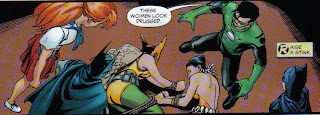
Disguised as Green Lantern (in Kyle's newer costume, which I'm sure he'd appreciate) Bruce 'raises a stink' and socks Hara in the face. He then has to take a few shots from Aiko, until he can kill the lights, free the drugged girls, and change into Batman.
Who would've thought a schoolgirl's uniform would be the better choice of outfits?
Aiko and Mighty Giant are apparently the all-purpose superpowered muscle that seems to show up a lot at DC these days, and they deliver a pretty stout slapping to Batman. Hara shows off his stolen Batarang, "Dipped in paralyzing venom," and asks Bats if he knows what "Jintai Hakuseijutsu" is. Bats knows, it's human taxidermy, and dryly notes, "It's true. Some guests got to keep their costumes." Not a bad line there.
Of course, things go south pretty quickly for Hara after that: the Batarang intended for Batman ends up in Mighty Giant's back, and Batman tasers down Aiko. From a standing start, Batman punches Hara (down what looks like a flight of stairs, only for him to land in the cosplay room) and notes Hara's Yakuza bosses should have their invitations and be there shortly: having a comic-reading otaku is one thing, but apparently there's no room for a "deviant" in the Japanese mob. No offense to Japan, but don't you have to do something beyond the pale to be considered an unacceptable pervert there? Or is it that being a deviant isn't the problem, being a loud and noticeable deviant is?
Batman leaves, knowing Aiko heard him, and lets Aiko take care of Hara. Now that seemed a little out of character, for Batman to turn his back on a probable murder. Maybe he just hates fanboys. And the story closes with a little banter with Alfred and Bruce.
There are some ups and some downs to this story: for longtime Batman fans, the plot probably seems pretty close to the Batman: the Animated Series episode "The Cape and Cowl Conspiracy." That one was based on "The Cape and Cowl Deathtrap!" Written by Elliot S! Maggin, art by Walt Simonson, in Detective Comics #450, reprinted in the Art of Walt Simonson.
But for me, the story seems a lot closer to the opening arc of John Ostrander and Doug Rice's Manhunter, the Mark Shaw version. Japan and the mask angle figure into that one quite a bit, although that's a four issue story with a little more meat to it. OK, that one's a personal favorite, so maybe not a fair comparison. And it's not fair for me to expect the writer or editor to have read every damn comic...
What I'm trying to remember, and I want to say this is from a fairly recent issue of Detective Comics, maybe even from "Face the Face," but aren't Batarangs tagged to give off a homing signal? Gah, I've been struggling to remember if I actually have this issue, or just read it or saw the preview or something; but Robin and Batman check out a display of Batarangs left all over Gotham--on rooftops, buried, embedded in walls, perps, etc. (I'm sure someone like Killer Croc or Bane probably has a couple lodged in them somewhere.)
Wherever this is from, it's a more recent development, and might be considered important. When Nightwing gave Batwoman a 'real' batarang in 52, I suspected it was a ploy for Batman to keep tabs on her; as it turned out, I guess it was Jason Todd taking a swing for the fences...Admittedly, passing yourself off as Nightwing because it gets more chicks than the 'Red Hood' makes sense, and is the only explanation I have for any of that.
Of course, they could just say the Otaku is what gave Batman the idea... Read more!
Wednesday, August 09, 2006

Ah, for the more innocent days when a character named 'Balloon Buster' didn't elicit howls of laughter and pointing. (Granted, about after about 30 seconds of deep thought I came up with worse names, but still.) Man, I'm probably the only person ever to search GCD for Steve Savage, Balloon Buster, but he did come up with a few hits, including Crisis on Infinite Earths #9. (Making reason #412 why Infinite Crisis is lacking in comparison: no Sgt. Rock, Unknown Soldier, Enemy Ace, Jonah Hex, Warlord, Anthro...)
Today's panels are from Batman: Legends of the Dark Knight Annual #7, "I Am a Gun." Written by James Robinson, art by Steve Yeowell, flashback sequences by Russ Heath. If this had been an old issue of Brave and the Bold, the logos for Batman and Steve Savage, Balloon Buster would've taken up about a third of the cover. This was the year DC's theme for the annuals was "Pulp Heroes," mixing their regular super-heroes with the traditions of older, pulp adventure magazines and comics; mostly crime, with the occasional dinosaur or sci-fi story.
Through the flashback sequences, Robinson and Heath do a stellar job of making you care about DC's number one WWI pilot that's not Enemy Ace, Steve Savage. The story also makes a nice bookend to previous tales involving Batman and Enemy Ace, without Batman ever meeting either one.
Savage lives up to his name, as he takes revenge on the German deserters that murder his wife-to-be at the closing days of the war. His mantra, "I am a gun!" seems somewhat out of place, almost more like something Enemy Ace would think while another pilot is claimed by the 'killer skies!' Batman notes that the dogfights between Savage and Von Hammer were inconclusive: The Hammer of Hell was a cold, emotionless killer (to my mind, he was a gun), while Savage was a wild, reckless cowboy; as Batman puts it, the two cancelled each other out.
But the Ace had a better nickname. By far.
The only other Balloon Buster stories I've read have been crossovers with Enemy Ace, but it's hard to imagine him as having the depth of character of the Hammer. And that's OK: not everyone is going to be a tortured soul, although Robinson appeared to be working on that.
Back to the comic at hand: Batman is talking to Smitty there, who is about to grab a hostage and set up aerial dogfight hijinks; when Batman should probably just be punching him out. Doofy 'costume' notwithstanding, Smitty had killed his partner by throwing him out a plane prior to this. So, I can't decide if this is 'Batman trying to resolve a situation without breaking anyone's jaw,' or 'Batman sitting on his hands so the plot moves forward.' Still, this is one of the only 'Pulp Heroes' themed annuals I can remember; although I know I've read others, they probably weren't great.
In the conclusion, as one of the mysteries of Steve Savage's life is revealed, Batman at first declines a celebratory glass of wine, but concedes to a drink in Savage's honor. His initial refusal makes him look like he has a Bat-rod up his ass, but Batman drinking is probably one of those things editors nash their teeth over: is he setting a good example for the kidlings if he has a glass? (But, didn't he get smashed after the death of Stephanie Brown? In fairness, I didn't read those: I caught Spoiler's first issue, and her first issue as Robin, but since it was obviously a short-term gig, I didn't stick around for Tim to come back or the end.) I figure Batman probably drinks a bit as part of his Bruce Wayne act, but doesn't get a lot of enjoyment out of it. Good enough, let it go at that. And good issue: if you've enjoyed Robinson's other work, dig this one up.
In other news, I did find my wife the Britney-video-nonsense she was looking for, but since we have a dial-up at home, it was like watching three seconds of video every ten seconds. On occasion, though, that can work to advantage: from warrenellis.com I once checked out a 'Greenpeace horror video,' and it took me about ten minutes to watch a 30-second film. Which just made it all the more horrifying: I knew something was going to happen, but what? And when? The jerky, lurching way it moved reminded me of so many horror movies, and made the wait to see what happened almost intolerable, and of course it was a disappointment once the scary part finally moved like a series of still photos on my computer. But during the wait, it was incredible. Which is probably true for a lot of things.
Read more!