Showing posts with label Abject Depression. Show all posts
Showing posts with label Abject Depression. Show all posts
Tuesday, April 16, 2013
Have I done one of those posts lately where I was looking for a specific book, didn't find it, and end up writing about whatever comic I found instead? Well, here we go! From 1979, The Flash #276, "Freakout!" Written by Cary Bates, pencils by Alex Saviuk, inks by Frank Chiaramonte.
Although the cover features Barry beating the JLA, the story is much, much darker. Previously, at a costume party, Barry was drugged with Angel Dust, and his wife Iris was badly injured by gibbering madman Yorkin. In his Flash costume, Barry manages to catch up to, and violently assault Yorkin; but that's a hallucination. Barry is actually in a hospital, and Iris died at the party; and Barry has no idea what is real anymore, until he sees her body at the morgue.
At the JLA satellite, Superman leads a small meeting with Batman, Green Lantern, and Wonder Woman; proposing a leave of absence for the Flash. They don't like it, but know the Flash will need all their help. And Barry arrives, but not wanting the help they were thinking of: he wants them to bring Iris back to life. When they sadly decline, Barry turns on them, claiming they were never his friends; and threatens to take the satellite apart...
Man, Green Lantern just looks pissed that Barry even asked...
I had the next issue when I was a kid, and I'm not sure I realized Flash's wife was dead, or that he was even married. Wish it was handy, too: a crazed Barry literally runs circles around the JLA, crushing GL and Bats against Superman and Wonder Woman! Flash would continue for another six years and 74 issues, to issue #350, but the shadow of Iris's death would linger for a long time. Even though she'd eventually come back, oddly enough. Read more!
Make no mistake: this is one of the most brutal, harshest, most depressing comics I'll ever read. And yet...in the end, I find it strangely uplifting. From 2004, Punisher: the End #1, written by Garth Ennis, art by Richard Corben. Spoilers this time around, but the title should be a tip-off...
Set "soon," the warden of Sing-Sing has just received orders to shoot the prisoners: as he explains it, "we can't have murderers and dope-dealers running loose in an atomic wasteland. That would be just plain untidy." With peace talks broken down, war is a given at this point. (Through Frank's later commentary, Ennis makes clear the notion that shouting "War on Terror" at China probably isn't a good idea...) The guards plan on riding out the war at the prison's bomb shelter, after they take care of the last prisoner, one kept far away from the others: Frank Castle, the Punisher. Finally caught by the police, Frank had been in good enough shape to keep killing criminals in prison. The bombs hit, killing the power, before the guards can take Frank out.
A year later, Frank leaves the shelter, with Peters, a short-con operator. Frank notes that the clouds appear to be burning, and Peters is dismayed that the radiation is still so high--they'll both be dead within 72 hours. But Frank has a goal, based on info from a dead prisoner...
The goal is another bunker, built under the site of the twin towers. The captains of industry, the kingmakers, the ultimate Haves, the secret owners of the world; and to Frank, the ones who wrecked the planet. And he's come for them.
The designer of the bunker, questioning the ethics of his employers getting away from a disaster they caused, ended up framed, thrown into Sing-Sing, and stabbed to death in a bunker. Which would've been the end of it, except the Punisher was in the same bunker. And the designer knew Frank wouldn't let that go...
One of the men tries to stop Frank, even though he knows he has nothing to bargain with: money's worthless, and Frank is dying of radiation poisoning anyway. But they have tapes from other bunkers: mainly, screaming and gunshots. These men, regardless of their crimes, may be the last humans on earth; and they have frozen embryos: they could save the human race.
Frank guns down the lot of them. "They could sell anything to anyone. Except me." Peters is appalled, but Frank says he's seen what the human race leads to. He then ask Peters why he was in D-Block. Peters admits he set a fire for insurance fraud, and accidentally burned down a kindergarden. Frank chokes him to death.
Quite possibly the last man on earth, Frank goes up to the street. As his hair falls out, and he catches fire, in his mind it's 1976, and he's on the way to Central Park, and his family. "Maybe this time I'll be in time to save them."
Even with an extinction-level event, and with Frank coughing up blood and sloughing skin...I still find this issue somehow, impossibly uplifting. Frank had a goal: punish the guilty. Through adversity, he stuck with his goal and achieved it. And now, at least, it's all over for him. There's only one way Frank's story can end, isn't there? Plus, Richard Corben just kills it on the art--think The Road as a revenge movie with Lee Marvin. If you ever take my word for anything, buy this issue. Now.
Weird, but three or four of the issues we looked at for Abject Depression week, are complete favorites of mine. This one especially.
Is there a word in English, for that queasy, uncomfortable feeling you get in your gut, when you see someone being completely and utterly screwed over, like Charlie Brown in an old Peanuts strip? And not quite in the way like he's running at the football, and surprise, Lucy pulled it away again; but instead the shafting is novel, surprising, and goes on for an appallingly long time. Because Chris Giarrusso nails that feeling of injustice making your tummy hurt, in "Cereal Quest" from Spidey and the Mini Marvels #1.
The GCD's synopsis reads "Wolvie has a number of adventures buying a box of his favorite cereal after his thoughtless teammates devour the last bowl." 'Adventures,' may not be the right word; as they seem like the same adventures Sisyphus had. "Kafkaesque" would be another word for it. And that's for a sixteen page story where Wolverine goes to the store. (A younger, cuter Wolverine, but that just makes it weirder.)
After the dickish X-Men eat all of Wolvie's cereal, he angrily slashes the table and stomps off to get more. Short-cutting through the woods, Wolvie frees a bear cub from a bear trap; for his trouble, the bear mom drives him out of there. Literally, with a driver. (That sets up an offhand joke later, but it's just weird.)
Hit by a car, Wolvie's admantium skeleton and healing factor mean he'll be fine, but the driver yells at him for denting his car. Next, at the supermarket, Wolvie is too short to reach the last box of X-Crunch. Asking a shopper to get it down for him, he's a little too enthusiastic, and the shopper keeps it for her daughter. He goes to a stockboy to ask for more, and is told to cram it; so drastic measures have to be taken...
This next sequence just makes my tummy hurt every time I read it: at the counter, the salesgirl asks Wolvie where his mommy is. "I don't have one. I'm an orphan." "Nonsense! Everyone has a mommy! You probably just haven't looked for her hard enough." Giarrusso's Wolvie is far more controlled than the typical Marvel version, who probably would've stabbed everyone in the store by now, but it's just getting started. The salesgirl tells Wolvie the register is jammed, but suggests he doesn't really need a receipt. Or a bag. Fine, until Wolvie gets stopped by the manager for shoplifting, who takes him back to the register.
To further ice the cake, outside Wolvie's attacked by Sabretooth, Toad, and the Blob. By this point, even in a kid-friendly book, readers would completely understand if Wolvie cut the lot of them into strips; but he settles for outsmarting the Blob, then getting a helping golf-club from the momma bear...
Finally back home, Wolvie pours himself his long-awaited cereal, and then, no milk. Luckily, at least one of his teammates isn't a dick: Nightcrawler!
I'm pretty sure Nightcrawler just stole that milk. Good for him. Still, if you think that means a happy ending for Wolvie, you haven't been paying attention. Also, Cyclops continues being a complete tool, for good measure. And for further depression, as Comic Book Legends Revealed pointed out, Giarrusso's Mini-Marvels were phased out for inferior Superhero Squad strips--in the style of the toys and cartoon, but not as good.
I used to work at a music store (a terrible and now defunct chain store, where I worked not especially well) and I still have some promo CD's from that time. One of them was the soundtrack for Dancer in the Dark, which I had for several years before actually seeing the movie. Actually, I only think I caught the last half-hour of the movie, but while the soundtrack breaks my heart, even watching part of the movie was like watching a sack of puppies and kittens drown in your washing machine, then having to reach past them to put your clothes in the drier so you can go to a funeral. (Apparently making the film was no picnic either, and I'm not sure Björk ever made another film.)
Why do I bring this up? Because although it came out a couple years after today's issue, the Björk/Thom Yorke duet "I've Seen it All" always comes to mind when I read it. From 1998, The Incredible Hulk #467, "The Lone and Level Sands" Written by Peter David ("ex-writer"), pencils and inks by Adam Kubert ("X-artist").
In the previous issue, Betty Banner suddenly came down with severe radiation poisoning. Despite Bruce's valiant efforts, she dies; and he believes his gamma radiation may be what killed her. Ten years later...an unseen freelancer from the Daily Bugle (named Peter...) interviews Rick Jones.
Rick begins telling the story, even though he wasn't there for some of it: as he and Marlo get the news, and as Thunderbolt Ross screams and waves his arms at his son-in-law, Bruce calmly makes his first suicide attempt moments after Betty's death. Stopped by the doctors, Bruce is put in a secure room; with tranq-guns set to automatically fire if his heart rate goes up (which would signal his change into the Hulk) and Ross continues glaring at him.
When Rick (who was in a wheelchair at the time) visits Bruce, it's readily apparent that, to use the technical term, he's cracked. Describing it as "a going away party for me," in his mind Bruce is surrounded by dozens of friends and foes he's met over the years. Quoting Percy Bysshe Shelley's "Ozymandias," Bruce tries to explain to Rick that those vast and trunkless legs are the Hulk's; there is nothing left without Betty.
Grasping at straws, Rick suggests the Leader's resurrection machine that saved Marlo around issue #400. Although he plans to check that out, Bruce is pretty sure it's been destroyed; with that, he turns into the Hulk. Rick describes the change as calm, as if giving up humanity was now a blessing for him; and his eyes as "envious." When the reporter follows up on that, Rick isn't sure why.
Bruce then makes multiple suicide attempts, but is always stopped by the Hulk, which Rick sees as not just Bruce's anger, but also his survival instinct. (Something David had touched on before in Hulk: The End, another not-especially-uplifting tale...) The events rattled off next could easily have been another year or so worth of Hulk comics: the army tries to stop the Hulk, fails. Bruce jumps off the Empire State Building, but lands as the Hulk, then the Avengers show up. Bruce tries black magic, but hell is even enjoying his torment and won't take him.
Rick also tells of Betty's funeral--closed casket, which he says led to conspiracy theories; but she was cremated later. Thor parts the rain clouds there, creating a rainbow: "It was like a reminder that you're just supposed to keep going, no matter what life throws at you." Which leads into Bruce's last visit to Rick.
Late at night, after a fight with his wife, Rick can't sleep, and plays the harmonica. Bruce seemingly appears from nowhere, wearing shades and smoking a pipe; making casual conversation about the blues and the song Rick was playing the day they met on the gamma bomb test range. (Buddy Holly's "That'll Be the Day That I Die," as described here.) Bruce describes his various suicide attempts as "a permanent solution to a temporary problem," and refers to "Ozymandias" again: someday, he will be gone; his legacy nothing but rubble. (Ironic, since the Hulk's legacy was rubble...) But that's OK: Bruce tried to find power, to be the strongest one there is, yet the only power that means anything is the power to help others. Leaving Rick for the last time, Bruce's eyes glow green.
The reporter asks if Rick worries about the Hulk, and Rick says he has other things to live for; like his daughter, Betty. (Rick also seems to have his "comic awareness" from his Captain Marvel days, since he wonders if he's not in an alternate, unofficial timeline.) Although the reporter wants to hear more, Rick feels he's said enough.
This was, of course, Peter David's last issue of the Incredible Hulk, ending a twelve-year run. (And it wasn't quite his "last" issue, he would have a brief return in 2005.) It really says something that this issue is so sad even though the new writer (poor Joe Casey, as we've seen a couple times) would have to immediately start backtracking from it--the Abomination poisoned Betty, not Bruce's radiation; and Thunderbolt Ross did save Betty's body. (Ross had been dead himself for a long stretch, so that's not completely unreasonable.) And of course, now Ross is the Red Hulk and Betty the Red She-Hulk, which strangely just makes me even sadder.
Since most of us don't live in a universe with super-heroes, we don't have to deal with the trauma of super-villain attack, fridged girlfriends, team breakups, continuity reboots, or any of that. Most of our damage is doubtless emotional.
Like that makes it better. Still, time heals all wounds, or sometimes causes them. Like this afternoon's book! From 1997, Dark Horse Presents #118, "Five Years and Counting" Written and illustrated by Evan Dorkin. This was a Hectic Planet story, and HP is what Dorkin's sci-fi/ska/soap Pirate Corp$ mutated into--less adventure, more relationship-oriented. Or, more accurately, the wreckage left post-relationship, usually.
Case in point: Halby, the ostensible hero of the strip, wants to borrow a few bucks from his pals; who then mercilessly grill him about why: he has a date. No one they know..."I don't even really know her."
Five years ago, at the ripe old age of seventeen, Halby ran into (literally) a girl named Trudi Kershaw, from Long Island. He spends most of the rest of the day with her, immediately smitten; but she has a boyfriend, albeit one she's becoming slightly afraid of. When Trudi finally has to leave to meet "Artie, her jocko-homo boyfriend," Halby panics, and blurts out they should meet there in five years, if neither of them are with anyone. Agreeing, "just in case," she makes a note with her name, and the future date for him, and another for herself.
His friends chip in a few bucks for Halby, although they are understandably less than confident. "Don't get your hopes up," suggests one. "Huh, like hell he won't."
Buying "corny" flowers, Halby waits, in the rain, for twenty minutes. About the time he's feeling like a complete moron and ready to leave, he hears his name. From a big guy in a Knicks sweatshirt. Artie. Calling back to his friends, Artie can't believe the sad bastard showed up. He found the note in his wife's purse, although he says "it ain't like I'm threatened or nothin'," he wanted to see what would happen. Artie shows Halby pictures of himself, Trudi, and their two kids; shaking his head, he suggests maybe Halby should get out more. Laughing, Artie and his friends drive away, with Trudi looking back at Halby, completely trapped in her life.
As Halby's friends are still discussing whether his gesture is romantic, futile, romantically futile, or just stupid; Halby returns, piss-drunk.
"You can't wait for the past," says the noseless, grumpy Harm. "It never shows up."
If we had a better comics marketplace than the one we deserved, Dorkin would be making bank; cranking out more stories like these. This was the first of three he did for DHP: the second was a bit of a shaggy-dog story; but the third is just as heartbreaking for Elsie, the female lead. Good stuff. Good, soul-crushing stuff.
"Abject Depression Week" started off with the loss of a little girl--there's nowhere to go but up, right? How about a man, and a vigilante, unable to break the circle of violence? From 1982, Moon Knight #26, "Hit It!" Written by Doug Moench, art by Bill Sienkiewicz.
On a hot night in New York City, a man sees in the paper his father's obituary. Abused as a child, he now feels robbed of the chance to ever "pay him back" and seething with years of rage, goes berserk, punching his way through random bystanders on his way to the funeral parlor. (There is a rather amusing panel of the man plowing through a locked door like he was the Kool-Aid Man, only really angry.)
Moon Knight follows the trail of bloodied noses and banged-up jaws to the man, who has decked a priest and smashed open his father's coffin. He dares MK to hit him--why not? His dad did! The priest even extorts MK to pop the man one, but MK says there's been enough hitting tonight. Until the man hits him in the back of the head, and he's left with no other choice. (Well, that's not true; I guess Moon Knight could've stood there and let the man punch him until he was all punched out...)
It's a sad story, and it's a little more bittersweet in that it was pretty much the highwater mark of Bill Sienkiewicz's run on the book: he still did a few more issues, but felt he had peaked there. Not to underscore his involvement, but in an interview at Horror Comic Book News, Doug Moench says "I originally did 'Hit It!' as a 5-6 page story. Bill Sienkiewicz went crazy on the story. He turned it into a longer story, he kept expanding the panels on the story." (Check out the rest of the interview!)
Feeling good about yourself? Well-adjusted? At peace? Or at the very least not completely depressed? Well, don't get used to that: it's Abject Depression Week! Where we'll be looking at some of the most soul-crushing, heartbreaking, just plain sad comics I could find. And we're starting with a tear-jerker...although since this is comics it still involves a ton of fight scenes: The Question Quarterly #2, "Gomorrah Homecoming" Written by Dennis O'Neil, art by Denys Cowan.
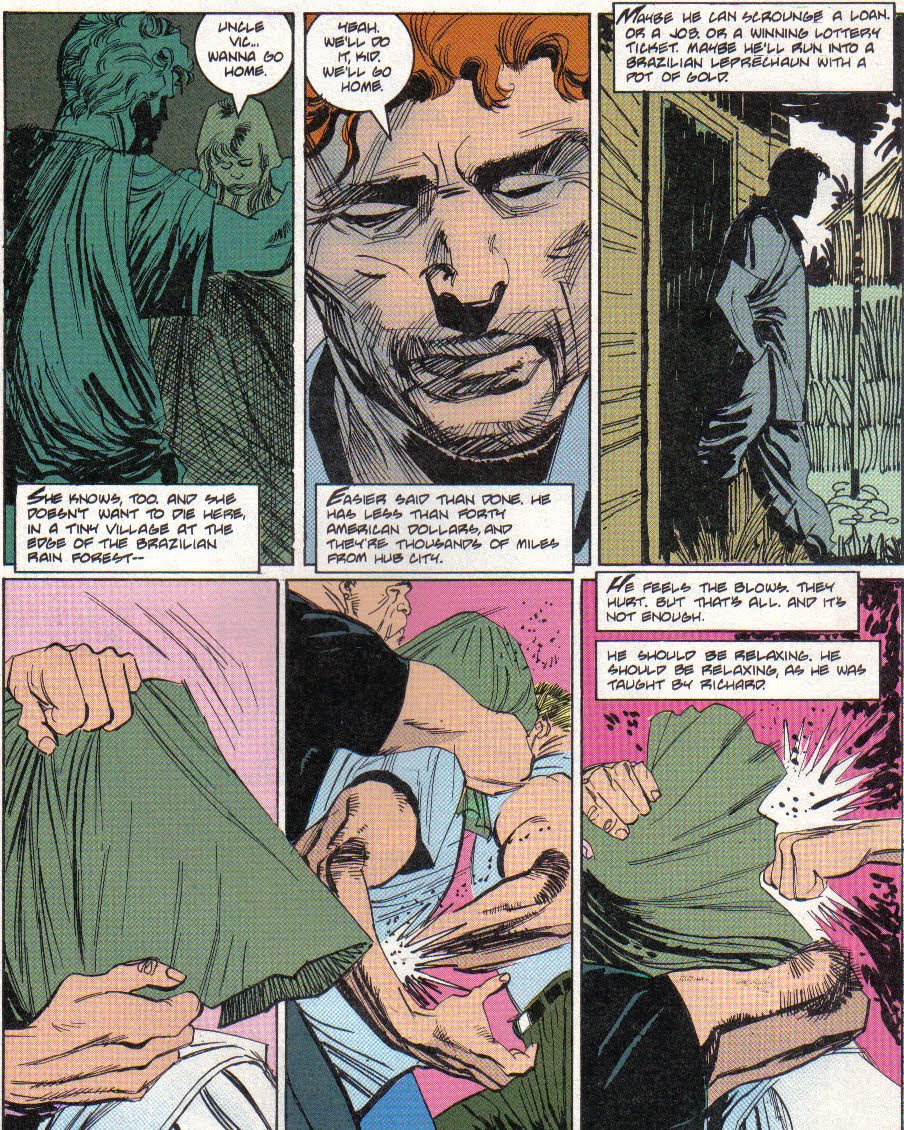
We took a look at the (almost as depressing) last issue of the regular Question series last year, and while he's had a couple adventures since then, Vic Sage has been in Brazil with Jackie, the daughter of Vic's love interest and mayor of Hub City, Myra Fermin. And Jackie is dying. She had been unwell before, but had been kidnapped the prior issue and left tied up in a shed in the rain, and now probably had pnuemonia if not worse. Vic knows she's dying, and she does too, and she wants to go home, to her mom.
Easier said than done, since Vic is starting with about forty bucks to get several thousand miles; and he gets a bag thrown over his head and beat up as well. Vic even recognizes his attackers--three drug dealers he had beat before--but is off his game. Only the intervention of new character Marco saves him; but Marco's saving Vic for himself, since he plans on fighting him to the death.
Marco is a capoeira master (predating Tekken's buttonmasher Eddy Gordo by six years!) who has devoted his life to fighting. After losing to a fighter we know as Lady Shiva (who, apparently just wanted to check out the fighting style) Marco requested a rematch, but she told him he would have to earn it by beating someone better. Like Richard Dragon. Or maybe Vic Sage. Vic thinks Marco is more than a little crazy (which Marco admits is probable) but he's a great help in getting back to Hub City.
Vic is also working through the trauma of having killed: in the previous issue, to save Jackie, he had to shoot a knife-wielding transvestite drug dealer. (That one was better than I'm making it sound here...) Now, repeatedly faced with the utter worst of humanity, he wonders if he could kill again. In Hub, Myra is reunited with Jackie, but she needs medicine. And the hospital's been taken over by a motorcycle gang. Vic is afraid of what he might do, but Myra gives him his old "No-Face" mask and gear: as the Question, Vic is able to get his head back in the game, and he and Marco clear out the hospital. Just not in time for Jackie, who dies before they get back.
The story ends with Vic agreeing to fight Marco, and to honor his friend by fighting him to the best of his ability...but I don't think you ever find out who won. The next issue, both of them are beat up a bit, but don't seem especially put out about it. And I'm not sure poor Jackie even gets a funeral. In fact, the GCD points out Jackie's referred to as alive in Batman/Huntress: Cry for Blood #3.